D-Tale chart filter vulnerability opens door to remote code execution
This month’s campaign features a spotlight on CVE-2024-45595, a critical eval injection flaw in D-Tale.
Access the full spotlight below.
What is D-Tale?
D-Tale is a free, open source tool built with Python that provides a web interface for exploring and visualizing pandas DataFrames. It helps data scientists and analysts to inspect, filter, and chart data easily through a web browser. D-Tale is often used in Jupyter or research environments. Its integration with Python and user-friendly design have made it popular in academic labs, machine learning projects, and internal analytics platforms.
Overview of CVE-2024-45595
The CVE-2024-45595 vulnerability in D-Tale is a serious security issue related to the application’s chart filtering system. The custom_filters parameter, intended for dynamic data filtering, utilizes Python’s eval() function without proper checks or safeguards.
This mistake enables attackers to execute malicious Python code within the application through a standard interface. If someone exploits this vulnerability, they can execute code remotely on the system that runs D-Tale. The amount of control they gain depends on how the environment is set up. In many cases, this could result in full administrative access, file theft, or additional attacks on connected systems.
Attack flow
The attack unfolds in three distinct stages.
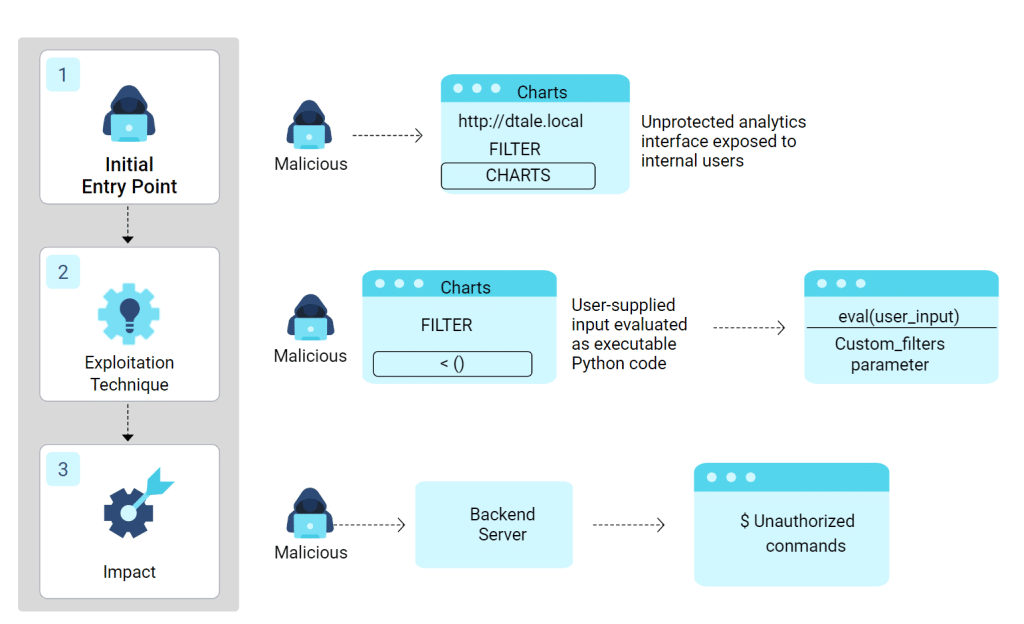
- Initial entry point: Access to the D-Tale interface, which may be exposed internally or, in some cases, publicly without authentication.
- Exploitation technique: Injection of crafted Python expressions into the chart query interface, triggering backend execution through
eval().
- Impact: Execution of arbitrary system-level commands, leading to data exposure, privilege escalation, or infrastructure compromise.
This vulnerability underscores the broader risk of using unsanitized dynamic evaluation in user-facing features. Recognizing the severity of CVE-2024-45595 is essential for both development and security teams.
What you’ll learn in this spotlight
Access the free spotlight below and dive deeper into this critical D-Tale vulnerability.
- Explore the anatomy of the attack chain
- Understand the details of the exploitation process
- Learn everything you need to know about evasion techniques, defense, and mitigation