Back to Blog
- What is the NICE framework?
- Key components of the NICE framework
- NICE framework vs. other cybersecurity frameworks
- How is the NICE framework used?
- NICE implementation strategies and best practices
- Future outlook and emerging trends
The cybersecurity skills gap continues to be one of the most pressing challenges facing organizations worldwide. Given the constant and increasing demand for experienced security professionals, the need for standardized approaches to cybersecurity workforce development has never been more critical.
The National Initiative for Cybersecurity Education (NICE) Cybersecurity Workforce Framework comes in to fill that need. NICE is a comprehensive solution designed to address these challenges through systematic workforce development.
Developed by the National Institute of Standards and Technology (NIST) in collaboration with government agencies, educational institutions, and private sector organizations, the NICE Framework has become the cornerstone for cybersecurity education, training, and career development across both public and private sectors.
What is the NICE framework?
The NICE framework is a nationally focused resource that establishes a common language and standardized approach for describing cybersecurity work, making it easier to communicate across organizations and sectors. Rather than being a rigid set of rules, it serves as a flexible foundation that organizations can adapt to their specific needs while maintaining consistency with industry standards.
At its core, the framework uses a building-block approach based on Task, Knowledge, and Skill (TKS) statements, defining the specific tasks, knowledge, and skills needed for various cybersecurity roles. These building blocks create a comprehensive taxonomy that enables organizations to precisely define job requirements, assess candidate qualifications, and identify training needs.
The framework’s strength lies in its practical applicability. It provides over 2,100 detailed TKS statements that describe not just what cybersecurity professionals do, but also what they need to know and the skills they must possess to perform effectively. This granular approach allows for precise workforce planning and development strategies that align with actual job requirements.
NICE v1.0 vs. v2.0
The transition from the previous NICE framework version to v2.0 represents a significant refinement of the framework’s scope and focus.
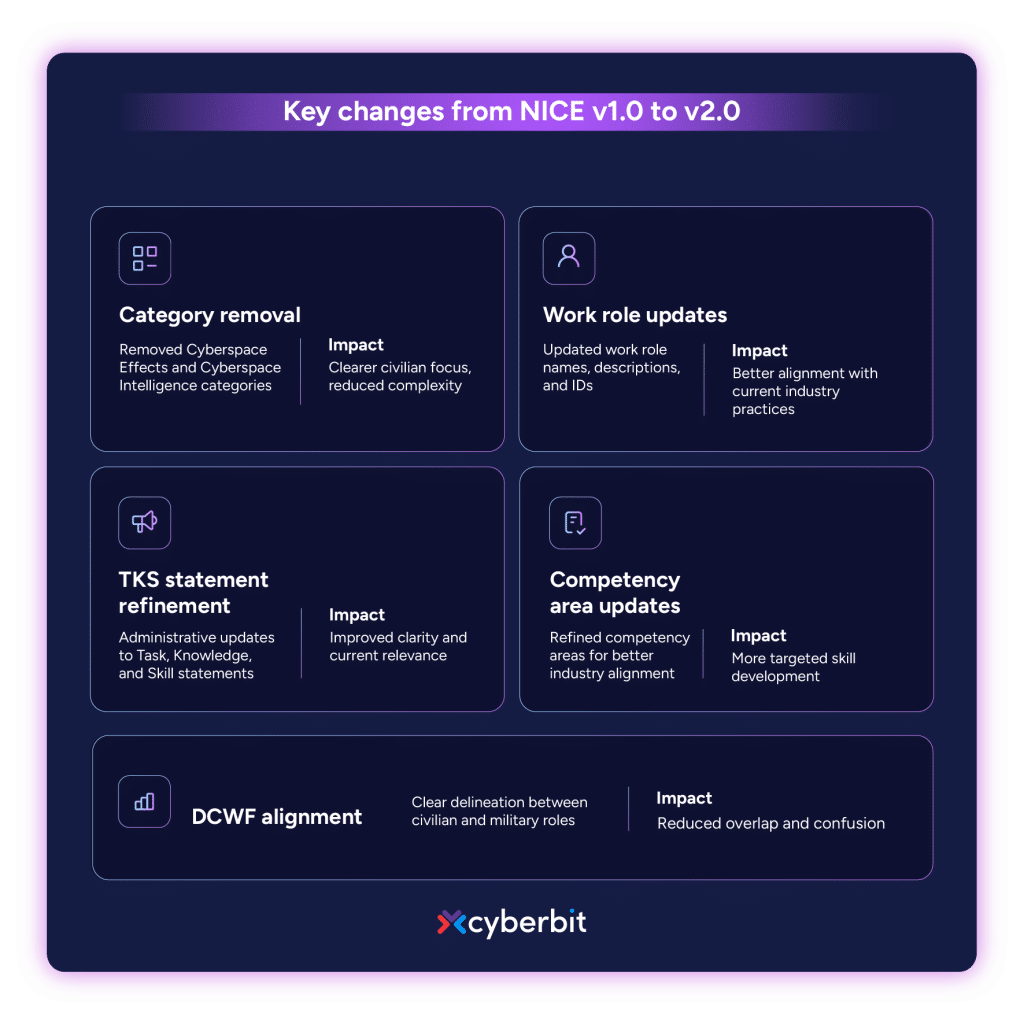
Removal of military-focused categories: The most significant change in v2.0 is the removal of two work role categories: Cyberspace Effects and Cyberspace Intelligence, along with their corresponding 12 work roles. These categories, which primarily relate to military operations and intelligence operations, have been transferred to the DoD Cyber Workforce Framework (DCWF). This change creates a clearer distinction between civilian/private sector cybersecurity roles and military/intelligence applications.
Enhanced civilian focus: With the removal of military-specific categories, the NICE framework v2.0 now provides a more targeted approach to civilian cybersecurity workforce development. This makes it more relevant and applicable for private sector organizations, educational institutions, and non-defense government agencies.
Updated work role structure: The updated NICE framework components include updates to work role categories, work roles, and competency areas, along with administrative updates to Task, Knowledge, and Skill (TKS) statements. These updates reflect current industry practices and emerging cybersecurity challenges.
Key components of the NICE framework
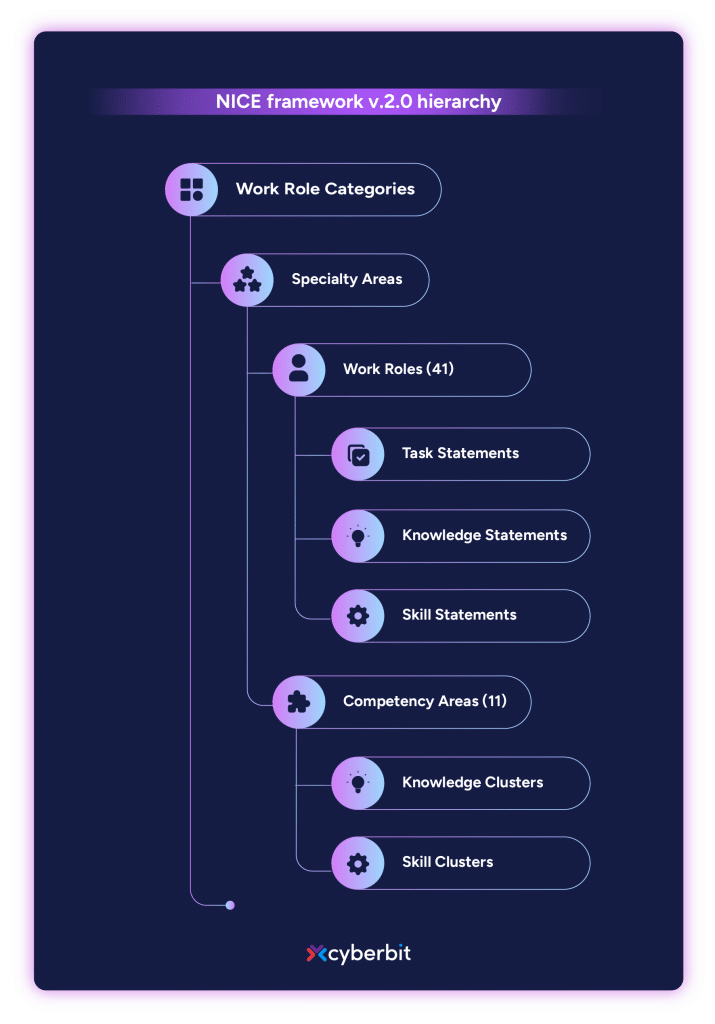
The NICE Framework is structured hierarchically, with each level building upon the previous one to create a comprehensive view of cybersecurity work.
NICE Task, Knowledge, and Skill statements
At the foundation of the framework are the TKS statements, discrete building blocks that describe the following.
- Tasks: Specific work activities that must be performed
- Knowledge: Information that individuals must possess to perform tasks effectively
- Skills: Observable capabilities that enable task performance
These statements have been administratively updated in v2.0 to ensure clarity and current relevance while maintaining the granular detail necessary for precise job descriptions, training program development, and performance assessment.
NICE work role categories
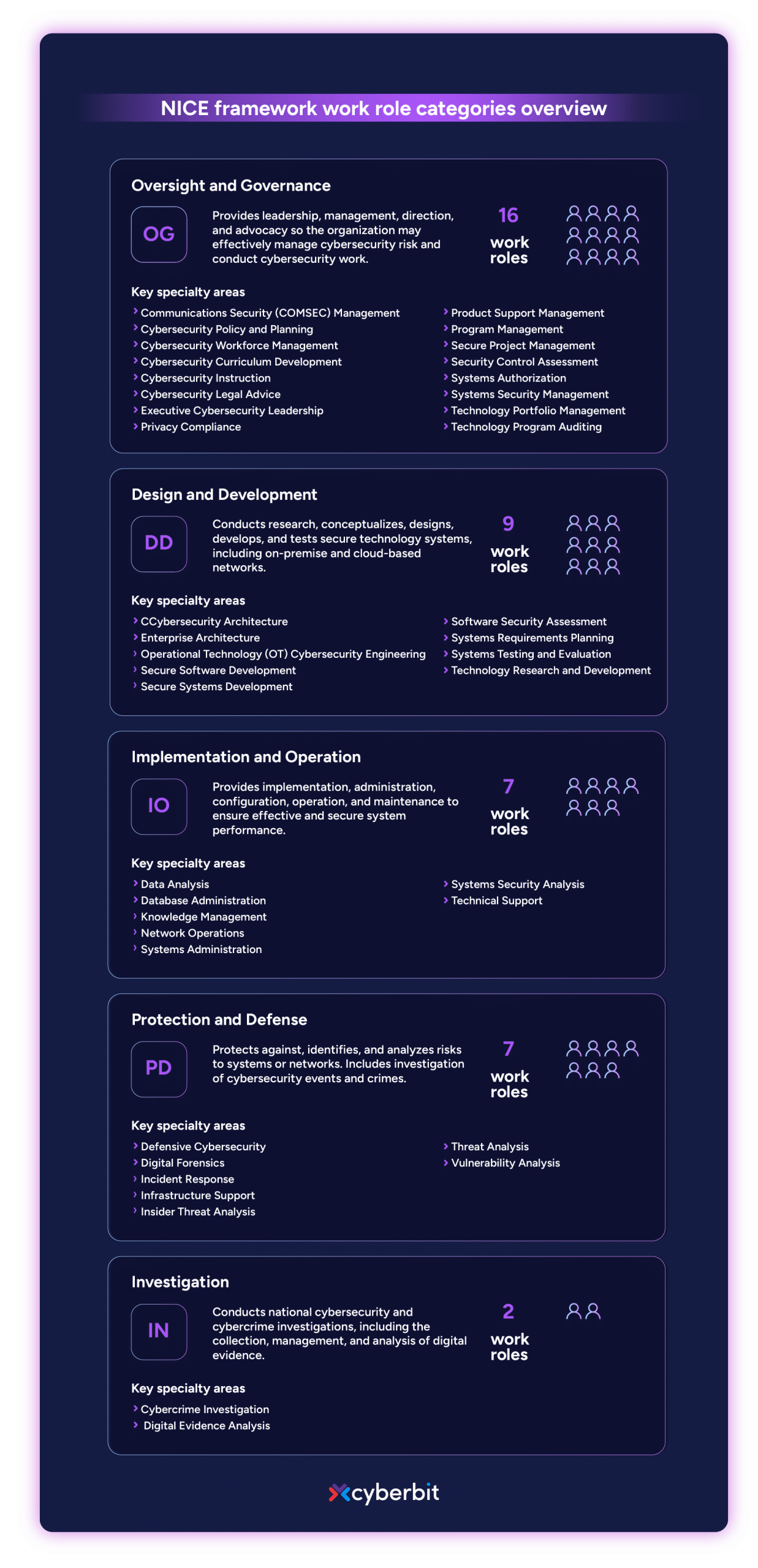
The framework organizes cybersecurity work into five broad categories that represent the fundamental areas of cybersecurity operations.
Oversight and Governance (OG): Provides leadership, management, direction, and advocacy so the organization may effectively manage cybersecurity-related risks and conduct cybersecurity work.
Design and Development (DD): Conducts research, conceptualizes, designs, develops, and tests secure technology systems, including on-premises and cloud-based networks.
Implementation and Operation (IO): Provides implementation, administration, configuration, operation, and maintenance to ensure effective and efficient technology system performance and security.
Protection and Defense (PD): Protects against, identifies, and analyzes risks to technology systems or networks, including investigations of cybersecurity events or crimes.
Investigation (IN): Conducts national cybersecurity and cybercrime investigations, including the collection, management, and analysis of digital evidence.
NICE specialty areas
Within each category, the framework defines specific specialty areas that represent more focused areas of expertise. These specialty areas provide a more granular view of cybersecurity work and help organizations identify specific skill sets needed for their operations. NICE v2.0 has refined these specialty areas to better reflect current industry practices and eliminate outdated classifications.
NICE work roles
The framework now includes approximately 41 distinct work roles (reduced from 52 in previous versions due to the removal of military-focused roles), each representing a specific cybersecurity position with clearly defined responsibilities and requirements. These roles range from entry-level positions to senior leadership roles, providing a comprehensive career pathway for civilian cybersecurity professionals.
NICE competency areas
The framework defines 11 competency areas that group related knowledge and skills statements. These areas represent clusters of capabilities that enable individuals to perform tasks in specific domains, such as risk management, incident response, or secure software development. Version 2.0 has refined these competency areas to better align with current industry needs.
NICE framework vs. other cybersecurity frameworks
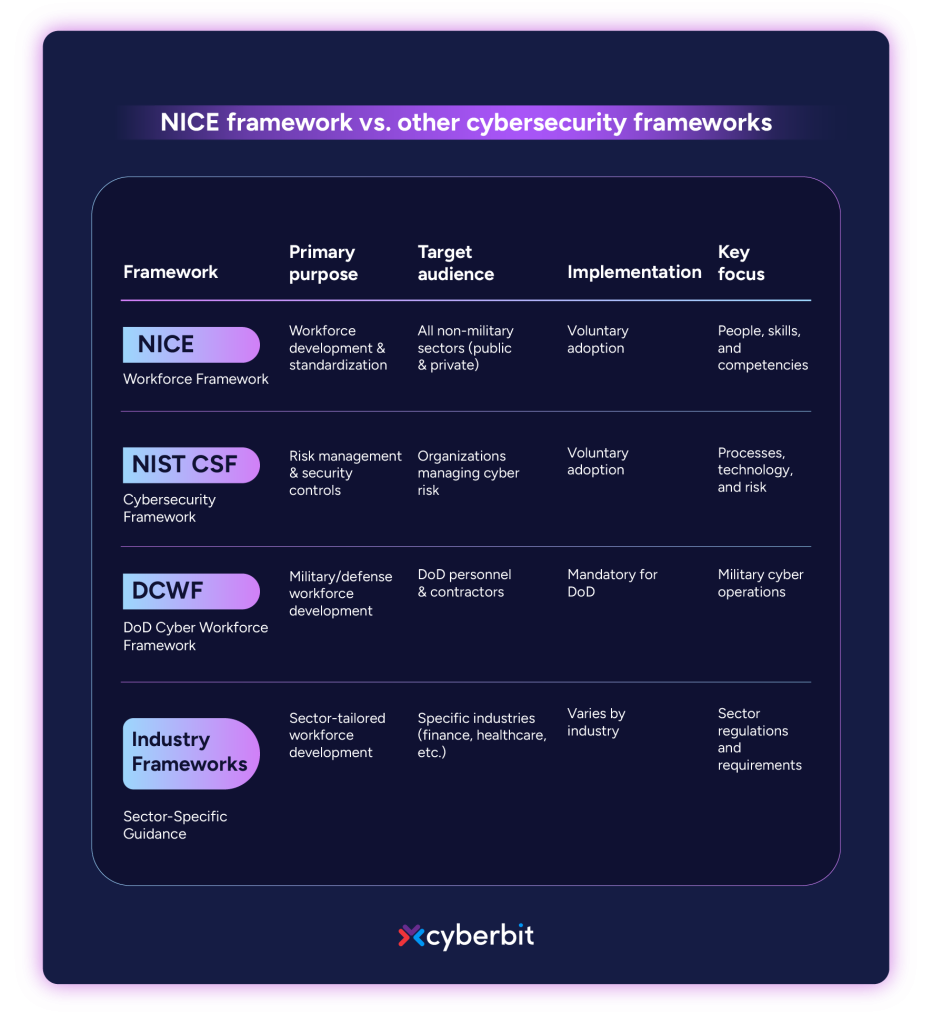
The cybersecurity industry includes multiple frameworks, each serving different purposes and audiences. Understanding these distinctions is crucial for proper implementation and avoiding common misconceptions.
NICE framework vs. NIST Cybersecurity Framework (CSF)
Despite both originating from NIST, these frameworks serve fundamentally different purposes.
- NIST CSF: Focuses on organizational cybersecurity risk management, providing a structure for identifying, protecting, detecting, responding to, and recovering from cybersecurity threats. It addresses what organizations need to do to secure their systems and data.
- NICE: Concentrates on civilian cybersecurity workforce development and human capital, defining who performs cybersecurity work and how they should be prepared. It addresses the people and skills needed to implement cybersecurity measures in non-military contexts.
The two frameworks are complementary rather than competing. Organizations often use both simultaneously, with NIST CSF guiding their security strategy and NICE framework informing their workforce development efforts.
NICE framework vs. DoD Cyber Workforce Framework (DCWF)
The Department of Defense Cyber Workforce Framework builds upon the NICE Framework but serves a more specialized audience.
- DCWF scope: Now includes the military-specific cybersecurity roles that were previously part of the NICE framework, along with roles designed specifically for Department of Defense cybersecurity workforce needs.
- NICE framework v2.0 scope: Focuses exclusively on civilian cybersecurity workforce development, making it more relevant for private sector organizations, educational institutions, and non-defense government agencies.
- Clear delineation: NICE v2.0 creates a clearer separation between civilian and military cybersecurity workforce development, allowing each framework to serve its intended audience more effectively.
NICE framework vs. industry-specific frameworks
Various industries have developed their own workforce frameworks.
- Financial services: Organizations like ISACA and (ISC)² have created role-based frameworks specific to financial sector cybersecurity needs.
- Healthcare: HIMSS and other healthcare organizations have developed frameworks that address HIPAA compliance and healthcare-specific cybersecurity roles.
- Critical infrastructure: Sector-specific frameworks for energy, transportation, and other critical infrastructure sectors focus on operational technology (OT) and industrial control systems.
The NICE framework v2.0 provides a stronger foundation for these industry-specific frameworks by offering a more focused civilian perspective that can be more easily customized for specific sectors.
How is the NICE framework used?
The practical applications of the NICE framework are diverse and span across multiple aspects of cybersecurity workforce development.
Career planning and advancement
With the removal of military-specific roles, civilian cybersecurity professionals now have clearer career progression paths that are more relevant to their work environment. The framework provides benchmarks for skill development and career progression within civilian contexts.
The framework’s comprehensive view of cybersecurity work enables professionals to identify transferable skills and plan transitions between different specialty areas or work roles. This is particularly valuable for professionals entering cybersecurity from other fields.
By understanding the progression from entry-level to senior roles within specific specialty areas, professionals can create long-term development plans that systematically build the necessary competencies for advancement.
The framework also helps professionals select appropriate certifications and training programs that align with their career goals and the specific requirements of their target roles.
Building a skilled workforce
Organizations can use the framework to develop comprehensive workforce strategies that consider both current capabilities and future needs. This includes succession planning, skill development programs, and recruitment strategies.
The framework’s detailed work role descriptions and TKS statements enable organizations to create precise job descriptions, develop appropriate interview questions, and establish clear qualification criteria. This improves the quality of hiring decisions and reduces time-to-fill for cybersecurity positions.
Organizations can use the framework to establish clear performance expectations, develop job-specific competency models, and create objective performance evaluation criteria. This ensures that performance management is aligned with actual job requirements.
The framework provides a foundation for developing targeted training programs that address specific skill gaps and align with organizational needs. This includes both technical training and professional development programs.
With the NICE framework providing clear career pathways and development opportunities aligned with the framework, organizations can improve employee engagement and retention. Professionals are more likely to stay with organizations that support their professional growth.
For collaboration and communication
The framework enables consistent communication about cybersecurity workforce issues across different sectors, facilitating collaboration across different non-military sectors, including government, education, and private industry.
Government agencies and private organizations can use the framework as a common foundation for workforce development initiatives, ensuring that public investments in cybersecurity education align with private sector needs.
Educational institutions can use the framework to align their programs with industry needs, while employers can provide clear guidance on the competencies they require from graduates.
The framework provides a foundation for international cooperation on cybersecurity workforce development, enabling countries to share best practices and coordinate training programs.
NICE implementation strategies and best practices
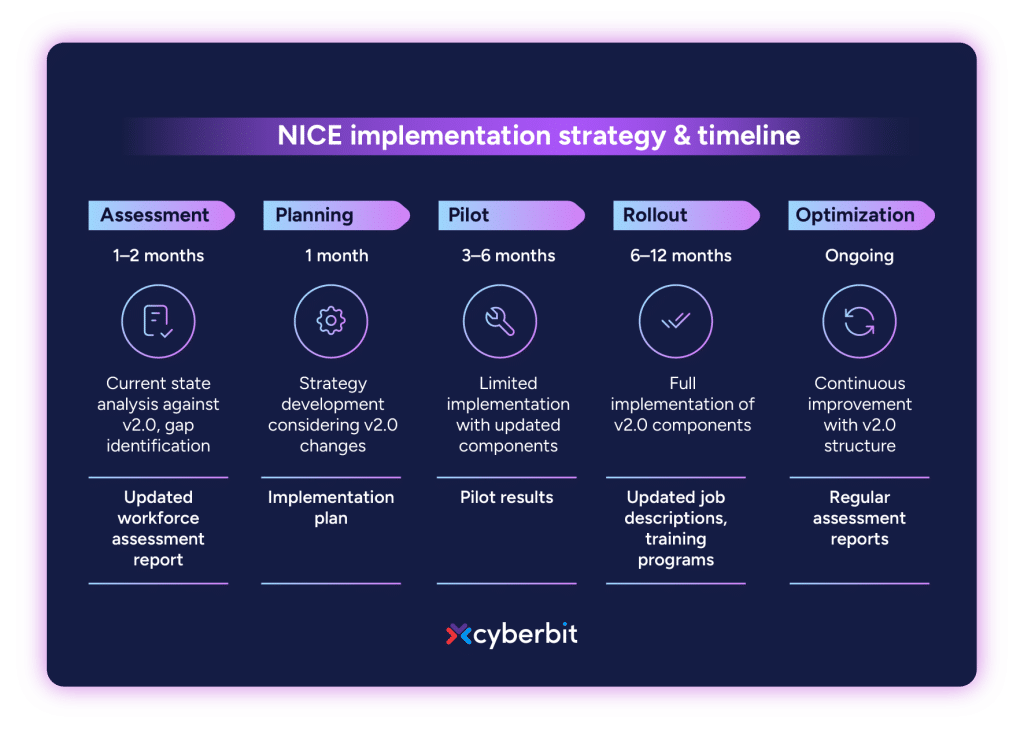
Successfully implementing the NICE framework requires a strategic approach that considers organizational context, existing capabilities, and long-term goals.
Organizational assessment
Organizations should begin by conducting a comprehensive assessment of their current cybersecurity workforce capabilities, mapping existing roles and competencies against the framework’s work roles and TKS statements. This assessment provides the foundation for all subsequent workforce development activities.
Phased implementation
Rather than attempting to implement the entire framework at once, organizations should consider a phased approach that focuses on high-priority areas or specific business units. This allows for learning and refinement before broader implementation.
Stakeholder engagement
Successful implementation requires buy-in from leadership, HR departments, hiring managers, and cybersecurity professionals. Organizations should invest in education and communication to ensure all stakeholders understand the framework’s value and their role in implementation.
Continuous improvement
The cybersecurity field evolves rapidly, and the framework itself is periodically updated to reflect new threats, technologies, and work practices. Organizations should establish processes for continuous review and improvement of their framework implementation.
Future outlook and emerging trends
NICE v2.0 represents a maturation of the framework concept, with a clearer focus on civilian applications and improved alignment with industry needs.
As cybersecurity becomes increasingly integrated into all aspects of business operations, the framework’s refined scope will enable more effective workforce development strategies.
And certainly, the framework’s influence will continue to expand beyond traditional cybersecurity roles, as organizations recognize the need for cybersecurity awareness and competencies across all business functions. The enhanced civilian focus of v2.0 will make this broader application more practical and relevant for non-military organizations.
Future updates to the framework will likely focus on emerging technologies and evolving threat landscapes, while maintaining the clear distinction between civilian and military cybersecurity workforce development established in v2.0.
If you’re interested in learning more about the NICE framework and its real-life application, I encourage you to register for early access to my upcoming discussion with Karen Wetzel, Lead of the NICE framework at NIST. We will discuss:
- Hiring and skill gaps
- Evolving and emerging technologies
- Modern ranges and training platforms
- Examples of real-life use cases
Fill out the form here to receive the recording of this webinar. Got any questions for me or Karen? Feel free to include them in the registration form!