What is a cyber range: Understand how it works, common use cases, and why you need it
Matthew Dobbs
August 21, 2025 |
19 min
Jump to
What is a cyber range?
Common cyber range use cases
How does a cyber range work?
Key features
Types of cyber ranges
Benefits of cyber ranges
Getting started with the right cyber range
Preparing your teams to defend against sophisticated, multi-stage attacks without putting real systems at risk is nothing short of a challenge. Not to mention that classroom theory-based training and the occasional drills just don’t cut it anymore.
That’s where a cyber range platform comes in. Cyber ranges offer a realistic, high-pressure environment where security teams can test and evolve their skills, tool knowledge, experience, and teamwork without risking actual systems.
What is a cyber range?
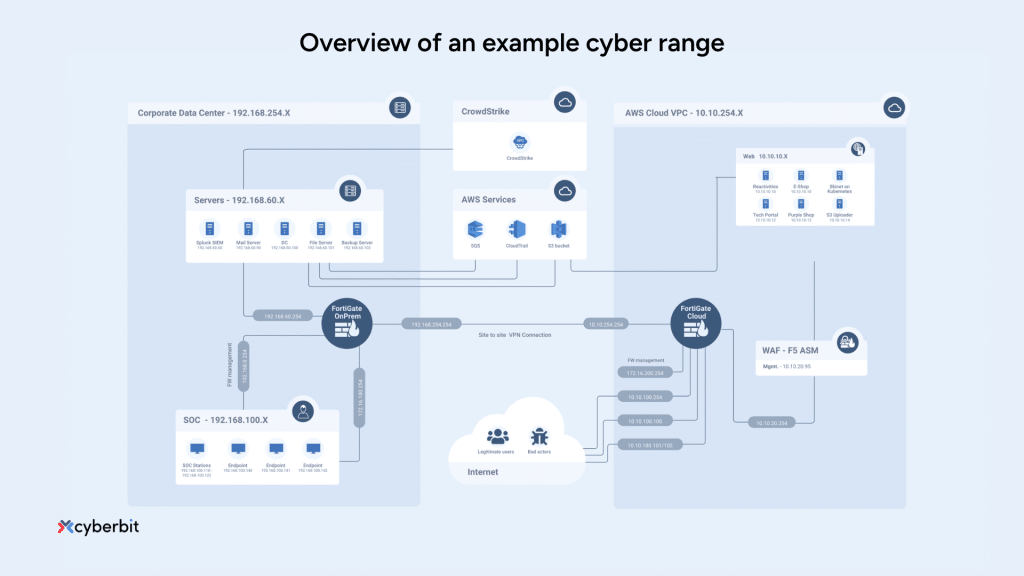
A cyber range is a virtual environment for cybersecurity training, testing, and research that simulates real-world networks and cyberattacks. These platforms create realistic training environments using virtual machines and controlled settings, allowing participants to experience the real thing, defending against digital attacks without risking actual systems or data.
Unlike static labs, cyber ranges are dynamic and adaptive. They can inject realistic attack vectors, replicate live traffic patterns, and evolve scenarios based on user actions. The result is an immersive “digital battlefield” where learners use actual security tools and respond as they would have in a live Security Operations Center (SOC).
In fact, cyber ranges replicate complex network infrastructures complete with:
Servers
Firewalls
Routers
Storage devices
Personal computers
These provide users with an authentic environment to deploy real-world cybersecurity tools such as penetration testing software, intrusion detection systems, and digital forensics applications. This realistic simulation allows participants to safely practice defending against specific cyber threats, including malware and ransomware.
What’s the difference between a cyber range and a lab?
While both provide hands-on environments, a lab is typically static, serving as a safe place to practice configuring a firewall or running a forensics tool. The focus of a lab is often on individual skills in isolation.
Cyber ranges, by contrast, offer dynamic, scalable environments that can simulate entire enterprise networks.
This distinction matters: labs teach the how, while cyber ranges prepare teams for the what if.
One more differentiating factor is the cyber range’s ability to provide collaborative, team-based training experiences. While labs typically serve individual learners, cyber ranges can accommodate entire security operations centers, allowing teams to practice coordinated incident response, threat hunting, and crisis management.
Common cyber range use cases
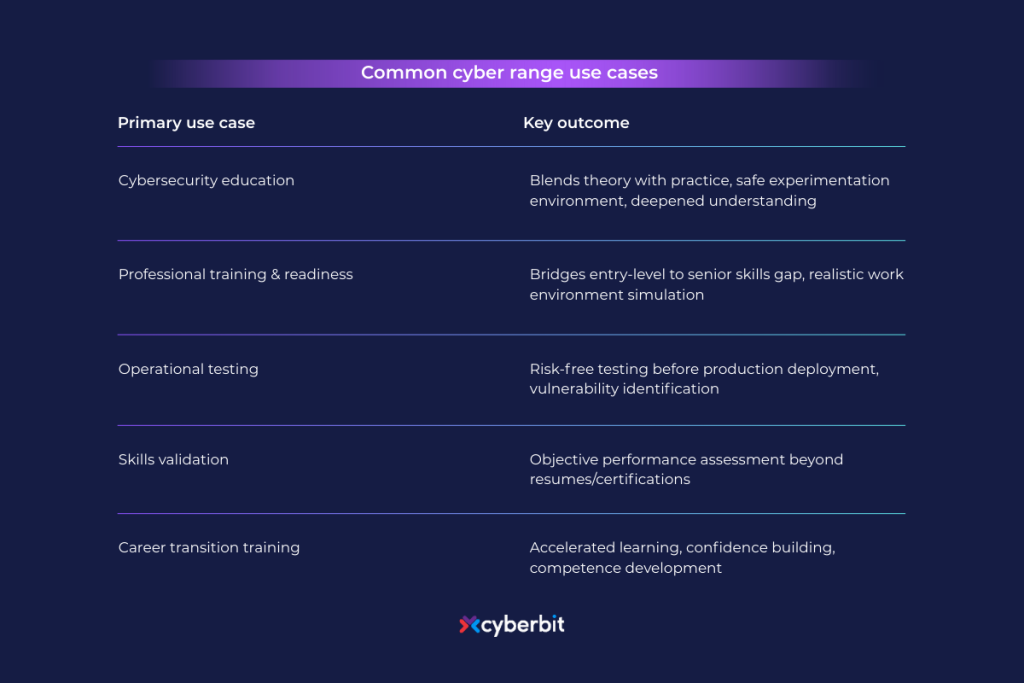
The versatility of cyber ranges makes them valuable across various sectors and applications. The National Institute of Standards and Technology (NIST) has identified several primary use cases that demonstrate the broad applicability of these platforms.
Let’s break them down.
Cybersecurity education
Academic institutions use cyber ranges to blend theory with practice, guiding students from basic networking concepts to complex multi-vector attacks. The controlled environment lets learners experiment, fail safely, and deepen understanding.
Professional training and readiness for specialists
SOC analysts, threat hunters, and forensics experts use cyber ranges to rehearse against targeted scenarios, whether that’s an insider threat, a zero-day exploit, or an advanced persistent threat (APT).
By the way, if you’re interested in diving deeper into some of the world’s most dangerous APTs, go check out our monthly campaigns.
APT44 aka Sandworm
A destructive threat group linked to Russia’s Unit 74455. Active since 2009, it targets governments, defense, energy, media, and civil organizations, disrupting elections, leaking data, and attacking critical infrastructure.
A sophisticated threat group widely attributed to the Chinese government. Active since at least 2006, their primary objective is espionage and intelligence gathering.
An Iranian state-sponsored cyber-espionage group that primarily targets governmental organizations, defense contractors, research institutions, and human rights activists.
Cyber ranges help bridge the gap between entry-level knowledge and the sophisticated skills required for senior cybersecurity roles. Participants can practice analyzing complex attack patterns, conducting digital forensics investigations, and implementing advanced security measures in realistic environments that mirror their actual work settings.
Operational testing
Organizations introducing new products, infrastructure changes, or major software updates can stress-test their security posture in a simulated replica of their environment before going live. These simulations can help SOC teams identify potential vulnerabilities, test security controls, and refine their defensive strategies before deploying changes to production environments.
Skills validation
Rather than relying on resumes or certifications alone, hiring teams can watch candidates respond to realistic incidents. That truly changes the hiring game, allowing hiring managers to more accurately measure:
Technical ability
Problem-solving
Composure under pressure
Career transition training
For professionals moving into cybersecurity from other fields, cyber ranges offer accelerated, immersive learning that builds confidence and competence faster than theory-based programs alone.
Who uses cyber ranges and why?
As you can imagine, with such versatility and applicable use cases, cyber ranges serve diverse sectors, each with unique requirements and objectives.
Finance, banking, and insurance
These industries rely heavily on cyber ranges to prepare teams to effectively respond to the sophisticated attacks targeting financial institutions while maintaining the strict regulatory compliance required in the financial sector.
Organizations within the finance sector face constant threats from cybercriminals seeking to exploit vulnerabilities in payment systems, customer databases, and trading platforms.
Consulting and Managed Security Service Providers (MSSPs)
When securing multiple systems for multiple clients, you need to remain hyper-vigilant and current with the latest threat vectors and defensive techniques. MSSPs utilize cyber ranges to maintain the high skill levels required to protect multiple clients across various industries, and diverse environments.
Government agencies and institutions
Being under constant attack, government agencies invest in cyber ranges for national security training, preparing cyber warfare specialists and critical infrastructure protection teams. These applications often involve highly classified scenarios and require ranges capable of simulating nation-state level attacks.
Government cyber ranges frequently incorporate intelligence data and advanced threat modeling to create the most realistic training scenarios possible.
Enterprise organizations
Cybersecurity for enterprise organizations is not something to take lightly and requires painstaking commitment and investment to maintain a high level of readiness. Enterprises across all industries implement cyber ranges to strengthen their internal security capabilities, validate their incident response procedures, and ensure their teams remain prepared for evolving cyber threats.
How do universities use cyber ranges?
Universities have emerged as significant adopters of cyber range technology, integrating these platforms into their cybersecurity curricula. Higher education institutions use cyber ranges to give students a safe, authentic environment to apply theory to real-world scenarios.
Courses often progress from basic vulnerability scanning to advanced persistent threat simulations, building skills gradually while fostering collaboration. Many programs integrate cyber range exercises into capstone projects and research, helping graduates enter the workforce already fluent in SOC workflows and enterprise tools.
How does a cyber range work?
Cyber ranges operate through a sophisticated combination of virtualization technologies, orchestration software, and realistic network simulations that work together to create authentic cybersecurity training environments.
At the foundation of every top-notch cyber range lies a robust underlying infrastructure consisting of networks, servers, and storage systems that provide the computational power necessary to support multiple concurrent users and complex scenarios.
Participants interact with this simulated environment just as they would with production systems, using real tools, monitoring traffic, investigating incidents, and executing countermeasures.
Let’s look at the key cyber range components one by one.
Orchestration layer
This layer integrates the underlying infrastructure with virtualization technologies and target infrastructure, enabling the rapid deployment of customized training environments based on specific learning objectives or organizational requirements.
The orchestration layer serves as the brain of the cyber range, coordinating the various technological components and managing the dynamic creation and modification of training scenarios.
Advanced orchestration systems can dynamically scale resources, inject realistic network traffic, and adapt scenarios in real-time based on participant actions.
Virtualization
Virtualization technology reduces the physical infrastructure requirements while providing the isolation necessary to create safe training environments. While visualization is a key component of all cyber ranges, only the most realistic and sophisticated cyber ranges employ hypervisor-based solutions or software-defined infrastructure to create multiple independent training environments that can operate simultaneously without interference.
This virtualization approach allows ranges to maximize their resource utilization while maintaining the security boundaries essential for multi-tenant training scenarios.
Attack simulation
The target infrastructure represents the simulated environment where actual training occurs, replicating real-world IT and security infrastructure with high fidelity. Advanced cyber ranges incorporate profiles of commercially available servers, storage systems, endpoints, applications, and firewalls, creating environments that closely mirror what participants will encounter in their professional roles.
Within this infrastructure, realistic cyberattacks are launched against the simulated systems, ranging from automated malware deployment and phishing campaigns to sophisticated multi-stage attacks that mimic actual threat actor behaviors.
This infrastructure often incorporates threat intelligence, mapped to a framework, such as the MITRE ATT&CK, to simulate realistic attack techniques and defensive responses.
What is a cyber range exercise?
A cyber range exercise is a structured, scenario-based training activity that presents participants with realistic cybersecurity challenges requiring coordinated response and resolution. These exercises simulate authentic cyber incidents, from initial threat detection through complete incident resolution, providing participants with a comprehensive experience in cybersecurity operations.
Live-fire exercises represent the most advanced form of cyber range training, incorporating real-time threat simulation, dynamic scenario evolution, and collaborative team-based response activities. Participants work together as they would in actual security operations centers, analyzing threats, coordinating responses, implementing countermeasures, and conducting post-incident analysis to improve their defensive capabilities.
Key features
Most cyber ranges share some common key features, varying, of course, in the level of quality and expertise.
Realistic network simulation: The level of simulation realness forms the foundation of effective cyber range platforms, providing high-fidelity recreations of enterprise networks complete with authentic traffic patterns, user behaviors, and system interactions.
Dynamic scenario generation: Real and effective scenario generation enables cyber ranges to create diverse, engaging training experiences that adapt to participant skill levels and learning objectives. This capability allows instructors to modify scenarios in real-time, introduce new challenges, and customize exercises.
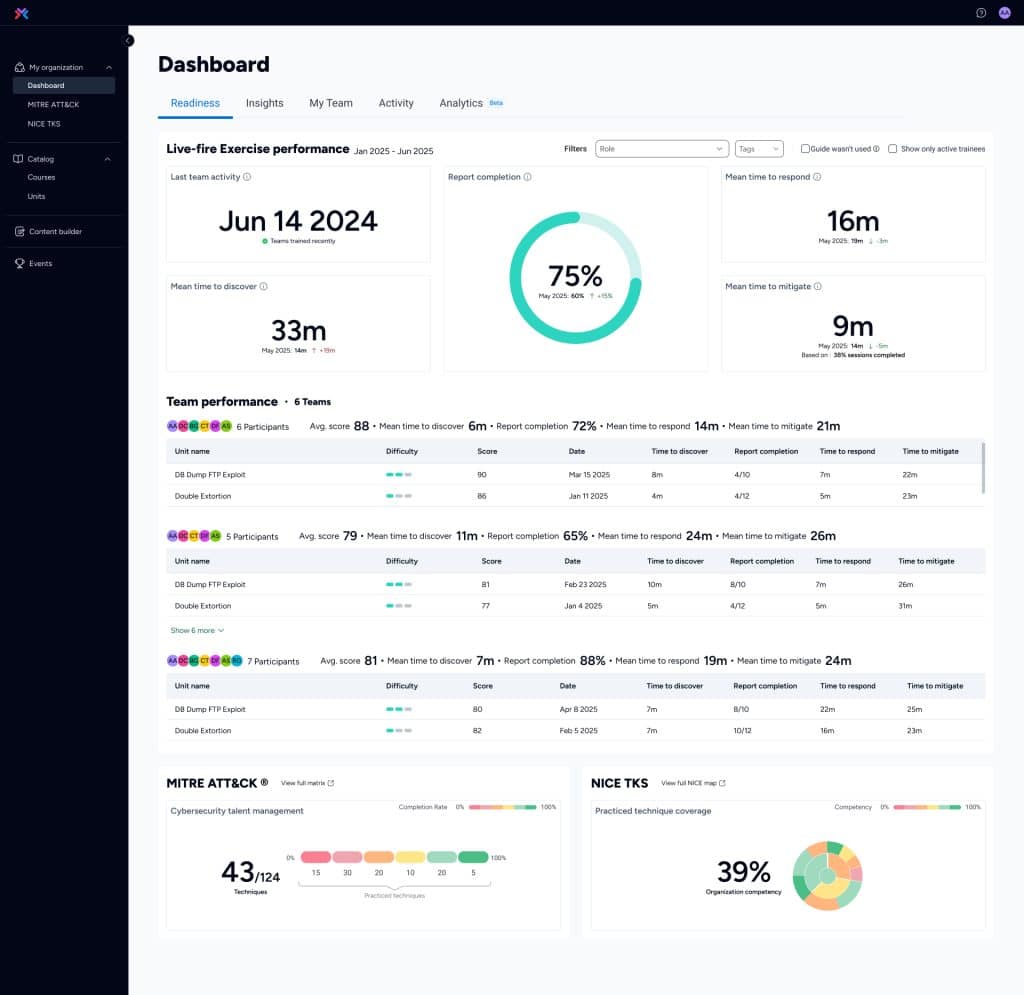
Comprehensive performance analytics: What good is training and fire drills if you cannot effectively measure performance? Providing detailed insights into participant performance, team collaboration effectiveness, and skill development progress is what differentiates good cyber ranges from world-class ones. These analytics capabilities enable instructors and team leaders to identify knowledge and experience gaps, track improvement over time, and customize future training based on individual and group needs.
Cyberbit readiness dashboard showing analytics on the performance of live-fire exercises and information on team performance, MITRE ATT&CK, and NICE TKS relevant to the exercise.
Types of cyber ranges
With so many different use cases and industries to serve, it’s only natural that not one type of cyber range can properly address every and all needs. In fact, there are several different types of cyber ranges. Let’s take a look.
Simulation ranges
These create synthetic network environments that replicate the behavior of real network components through software-based modeling. Simulation ranges execute within virtual instances, eliminating the need for dedicated physical network equipment while providing cost-effective, scalable training platforms.
They offer quick reconfiguration capabilities and utilize standardized templates, making them ideal for large-scale educational programs and standardized training curricula. However, they may experience limitations in accurately reproducing highly specialized or legacy infrastructure configurations.
Overlay ranges
Overlay ranges operate on top of existing real networks, servers, and storage systems, providing higher fidelity training experiences by utilizing actual network infrastructure. This approach offers increased realism but comes with higher costs and potential security risks to the underlying infrastructure.
Overlay networks are often implemented as global testbeds for research and advanced training applications where maximum realism is essential for effective learning outcomes.
Emulation ranges
These deploy cyber range capabilities on dedicated network infrastructure, where actual network, server, and storage infrastructure is mapped directly onto physical hardware. This approach transforms the physical infrastructure into the cyber range itself, providing closed-network environments with multiple interconnected components.
Emulation delivers the most authentic and true-to-life experiences, incorporating actual protocols, traffic flows, and system behaviors rather than simulated approximations.
Hybrid ranges
Hybrid cyber ranges combine features and capabilities from multiple range types, creating customized environments that meet specific organizational requirements. These ranges integrate various technologies and methodologies to provide optimal training experiences while balancing cost, realism, and scalability considerations.
Hybrid implementations allow organizations to leverage the benefits of a wide range types while minimizing their individual limitations.
SaaS (online) vs on-prem vs open source ranges
Cyber ranges can be categorized also based on their type of deployment. Let’s take a closer look at the differences, pros and cons of each.
Software-as-a-Service (SaaS) cyber ranges
SaaS cyber ranges, aka cloud-based cyber ranges, offer the fastest deployment times, typically allowing organizations to begin training within hours or days of initial setup and they are subscription-based.
Use case: Organizations seeking rapid deployment, scalable training programs, and minimal infrastructure management overhead.
Pros:
Fastest deployment times (hours to days)
High scalability and elasticity with automatic resource adjustment
Subscription-based pricing with predictable costs
Regular feature updates and maintenance handled by provider
No need for complex infrastructure management
Cons:
Limited support for highly specialized or classified training requirements
Not designed for scenarios that involve highly sensitive data
Less customization flexibility compared to other options
Ongoing subscription costs
On-premises cyber ranges
Locally deployed cyber ranges, on the other hand, provide organizations with complete control over their training environments and data.
Use case: Organizations with strict security requirements, classified training needs, or highly specialized customization requirements.
Pros:
Complete control over training environments and data
Support for highly customized scenarios and sensitive training
Maximum security and privacy protection
No external dependencies or internet requirements
Full customization capabilities
Cons:
Significant upfront investments in hardware and software
Ongoing maintenance responsibilities and costs
Longer deployment times
Requires specialized technical expertise for operation
Limited scalability without additional hardware investment
Open source cyber ranges
Open source solutions could not be absent from the cyber range offerings. Community-developed, or freely available cyber range platforms, provide access to source code for complete customization.
Use case: Organizations with strong technical capabilities seeking maximum customization flexibility while minimizing licensing costs.
Pros:
Minimal initial licensing costs
Complete access to underlying source code
Maximum flexibility for customization
Community support and contributions
No vendor lock-in concerns
Cons:
Requires significant technical expertise for implementation
Longer deployment times and higher resource requirements
Limited professional support compared to commercial solutions
Organizations must handle all maintenance and updates
May require substantial internal development investment
What about ICS/OT ranges?
Industrial Control Systems (ICS) and Operational Technology (OT) cyber ranges are a whole different beast, specializing in simulating critical infrastructure environments, such as power grids, water treatment facilities, manufacturing systems, and transportation networks. These specialized ranges incorporate authentic industrial protocols, control systems, and physical process simulations to train cybersecurity professionals in protecting critical infrastructure from increasingly sophisticated cyber threats targeting operational technology environments.
Benefits of cyber ranges
Cyber ranges provide benefits for organizations of all sizes and industries, including (but not limited to!):
Hands-on skill building to accelerate readiness through experiential learning
Team coordination to strengthen communication and role clarity under pressure
Safe testing for practicing high-risk procedures without impacting live systems
Measurable outcomes and quantifiable data on readiness and progress
However, to effectively assess the real-world benefits of investing in a cyber range, I invite you to go over the five whys. The “Five Whys” framework, originally developed at Toyota to uncover root causes, can also reveal the deeper value of cyber ranges.
So, let’s ask ourselves these five questions and see if we can uncover how cyber range platforms drive measurable security resilience.
If you want to dive deeper into the five whys of cyber ranges, I recommend you watch the full webinar below. Otherwise, check out the shorter Q&A version after the video.
1. Why have a cyber range?
A cyber range provides a safe, controlled environment to simulate real-world attacks without risking production systems. Teams can run live-fire exercises, test their incident response playbooks, and practice on scenarios they rarely face in day-to-day operations — whether that’s investigating Linux-based intrusions or handling specialized malware. Like going to the gym, it’s all about repetition: the more reps your analysts get, the stronger and more confident they become.
2. Why make the team better?
A stronger security team responds faster, communicates more effectively, and works more cohesively under pressure. Cyber ranges not only sharpen technical skills but also improve collaboration, role clarity, and decision-making in high-stress situations. Upskilling in both hard and soft skills boosts confidence, morale, and retention, turning the security team from a collection of individuals into a coordinated defensive unit.
3. Why keep improving against evolving threats?
The answer here is the ultimate buzz phrase of our days: the threat landscape changes daily. Aside from a buzz phrase, this is also the unfortunate reality. From ransomware-as-a-service kits to industry-specific attack vectors, adversaries are constantly innovating. A cyber range allows teams to focus training on the threats most relevant to their business, guided by frameworks like MITRE ATT&CK. This ensures defenders are not only ready for today’s known threats but also adaptable to tomorrow’s unknowns.
4. Why be prepared to defend systems?
Preparation protects more than just systems; it safeguards sensitive data, customer trust, and brand reputation. Many organizations also face strict compliance obligations, making readiness a legal as well as strategic necessity. The difference between a prepared team and an unprepared one can mean the difference between containing an incident quickly and suffering prolonged, costly downtime.
5. Why does it matter for the organization?
The ultimate stakes are financial, legal, and reputational. A serious breach can trigger fines, lawsuits, stock losses, and years of brand recovery. Involving leadership and cross-functional teams in cyber range exercises breaks down silos, aligns security priorities with business goals, and ensures everyone knows their role in a crisis. Investing in preparedness before an incident delivers far greater returns than scrambling to recover afterward.
Getting started with the right cyber range
Choosing the right cyber range platform means matching capabilities to your goals, whether that’s education, SOC training, candidate assessment, or operational stress-testing. Scenario variety, integration options, and realism should all be part of the evaluation.
The evaluation process should also consider both immediate training needs and future scalability requirements, ensuring that the selected platform can grow with the organization’s evolving cybersecurity program.
Technical considerations to keep in mind when auditing a cyber range solution include infrastructure requirements, integration capabilities, support for specific technologies or protocols, and compatibility with existing training programs or certification requirements.
Who has the best cyber range?
Ah, the million-dollar question! The cyber range market includes several established players, each offering different strengths and specializations. Major providers include government contractors specializing in defense and intelligence training, commercial vendors focusing on enterprise and educational markets, and specialized providers targeting specific industries or use cases.
Cyberbit stands out as a leader in the cyber range market, consistently recognized for its comprehensive platform capabilities, realistic training scenarios, and proven track record across diverse industries and use cases. Not to mention that Cyberbit’s position as a leader has been validated by independent analysts, including recognition in the Forrester Wave Leader 2023 report, which highlighted the platform’s advanced features, scalability, and customer satisfaction ratings.
Are there free or open-source cyber ranges?
Several open source cyber range solutions are available for organizations with the technical expertise and resources necessary for implementation and maintenance. These solutions include academic projects, community-developed platforms, and simplified training environments that provide basic cyber range functionality without licensing costs.
Popular open source options include The DETER Project, which provides network security experimentation capabilities, and various virtualization-based platforms that create isolated training environments. However, these solutions typically require significant technical investment for setup, customization, and ongoing maintenance, often making commercial solutions more cost-effective when considering total implementation costs.
As I mentioned previously in the comparison of deployment models, open source ranges offer maximum customization flexibility but require substantial internal expertise for effective implementation and operation.
Can I get cyber range as a service?
Absolutely! Cyber range as a service represents the most accessible deployment model for most organizations, providing immediate access to advanced training capabilities without the complexity and costs associated with infrastructure deployment and maintenance.
The Cyberbit platform delivers fully managed, cloud-based cyber range experiences, including Live-Fire Exercises for immersive, SOC-style training with no infrastructure buildout required.