Back to Blog

- Threat actors show no signs of abating
- The cybersecurity experience crisis is real
- Defining the battle-ready defender
- Building SOC team readiness
- The million-dollar question: How do you measure readiness?
- The evolution of the cyber defense mechanism
To protect themselves today, enterprises must build stronger defenses and greater cyber resilience, and the most effective way to do this is through extensive SOC team readiness.
SOC team readiness is established by turning security professionals into a frontline-ready, battle-hardened cyber defense team.
Threat actors show no signs of abating
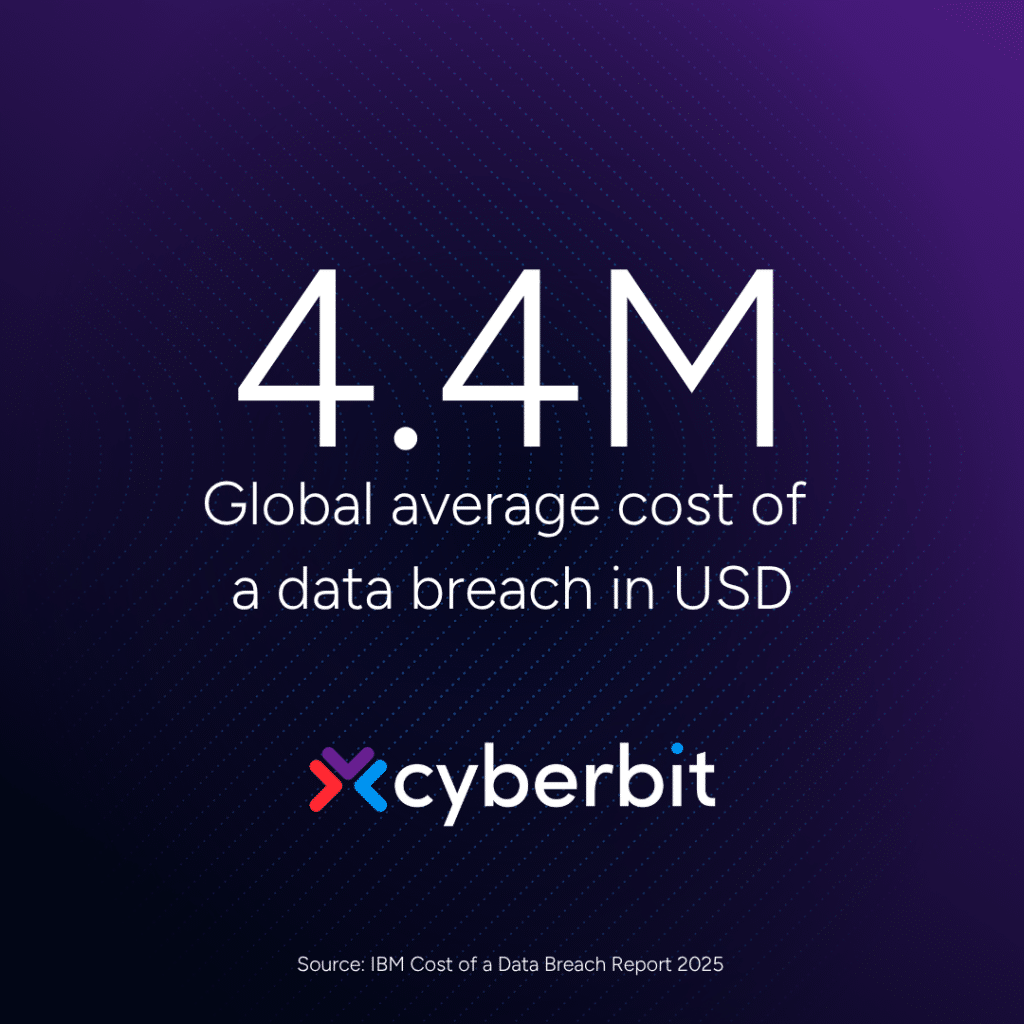
The urgent need for SOC team readiness has never been greater. Organizations are being attacked constantly, and the cost of these attacks is rising exponentially. According to the IBM data breach report, the average cost of a data breach in 2025 skyrocketed to 4.4 million USD.
And beyond the immediate financial and legal damage caused by these attacks is reputational damage. The Deloitte Consumer Review reports that 73% of consumers said they would seriously consider not using a company again if it failed to keep their data safe or lost their personal data.
The cybersecurity experience crisis is real
For years, we’ve been talking about the gap in the cybersecurity workforce and the lack of structured processes for implementing established cybersecurity best practices, as well as a lack of skilled experts with a clear, up-to-date understanding of how to identify, assess, mitigate, and apply those processes to respond to threats and vulnerabilities.
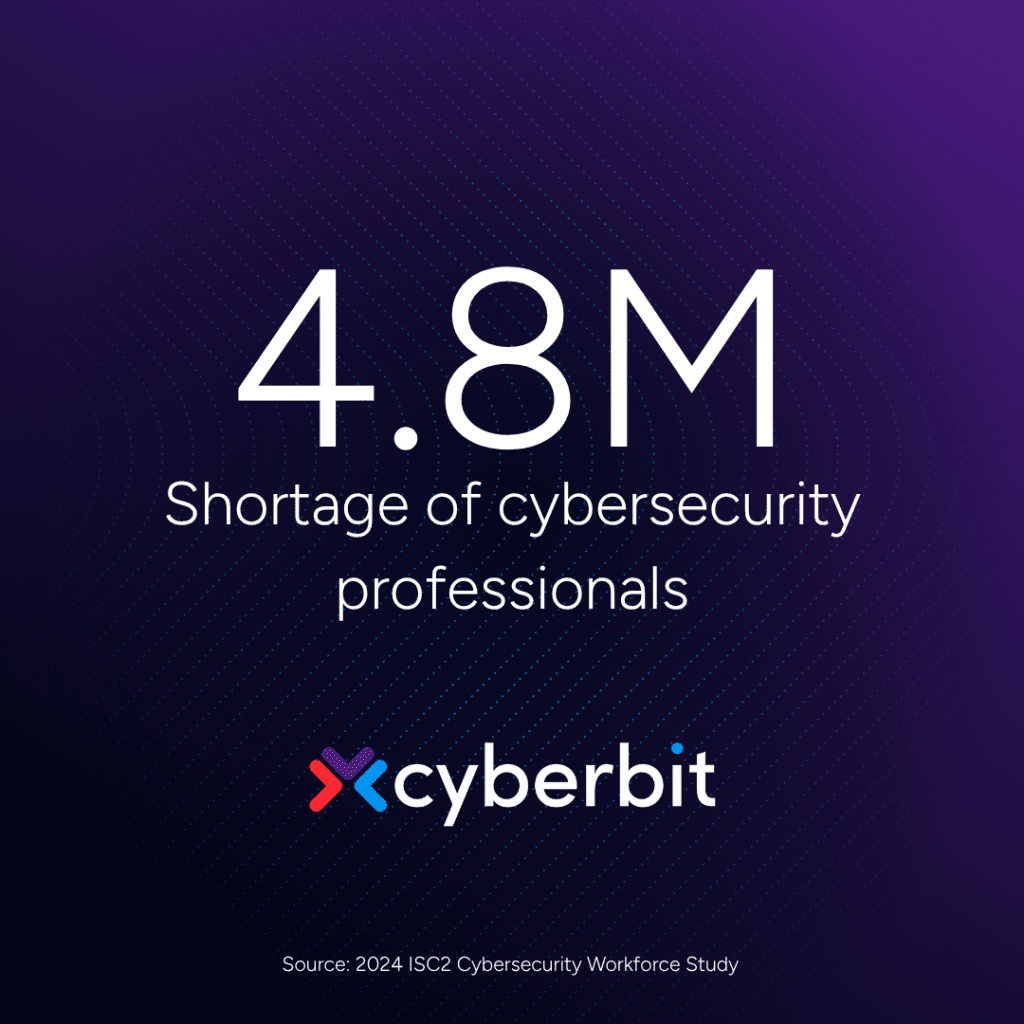
According to the 2024 ISC2 Cybersecurity Workforce Study, there is a shortage of 4.8 million cybersecurity professionals. Filling out these roles would help secure organizations properly. But is this shortage created due to a talent shortage?
Honestly, I don’t believe this is the case. There was a talent shortage 3, 5, or 10 years ago, but today, the real crisis and obstacle in filling cybersecurity positions is the experience gap.
As Karen Wetzel from NIST explained during our recent webinar, “There’s a little bit of a gap there about how do I enter a profession if I don’t have that expertise already? If I haven’t had those hands-on opportunities to show what I can do in a real workplace. And that’s where things like cyber ranges can really help, is to be able to make that jump from education and training to the actual doing.”
At the end of the day, organizations need not just the security tools and processes in place, but also people with real-life cybersecurity experience who can problem-solve, troubleshoot, and decide what to investigate, which tools to use, and how to use them.
Defining the battle-ready defender
Talking about battle-readiness can be a vague concept. So, let’s quickly break down what defines a truly battle-ready SOC team.
Reactivity and proactivity
Defenders must be capable of responding both reactively to known risks and proactively to unknown risks. We’re talking about a cybersecurity workforce that can develop and evolve to be able to quickly and expertly respond to cyber security threats that are also developing and evolving.
Owning the security strategy
A battle-ready team of defenders should be capable of designing, establishing, implementing, and maintaining defensive and offensive cyber strategies. Such a team possesses the knowledge and experience necessary to address the cybersecurity challenges they will inevitably encounter.
And they will, for sure, encounter them. According to Palo Alto Networks, the “general consensus among industry experts is that an organization facing a cybersecurity breach or attack is not a matter of if, but rather when.”
Building SOC team readiness
So, just how do you build SOC team readiness? What types of skills must your cybersecurity workforce possess? What knowledge do they need to acquire? And how do SOC readiness platforms and SOC KPIs come into play?
Here’s your go-to checklist:
- A solid, up-to-date foundation in cybersecurity theory, tools, and attacker tactics.
- In-depth understanding of the cyber security incident response life cycle for optimal triaging and response strategy.
- Extensive knowledge of enterprise security tools (e.g., Palo Alto, Fortinet, CrowdStrike) and how to use them effectively.
- Advanced detection, analysis, investigation, and remediation skills to ensure highest-level operational readiness when responding to real-world threats.
- Tested experience in handling advanced attacker behaviors such as Advanced Persistent Threats (APTs), lateral movement, data exfiltration, and others, so your team’s first exposure to an attack is NOT when your organization is under attack.
- Alignment with industry best practices as outlined by key industry frameworks such as NICE, ENISA ECF, MITRE ATT&CK, etc.
- Soft skills such as critical thinking, problem-solving, team management, and communication skills that can facilitate and promote security practices across diverse audiences.
SOC readiness platforms centralize the process of acquiring those skills and knowledge and provide defenders with the necessary hands-on experience to test their skills under fire. SOC KPIs are the metrics that bring the effectiveness of the readiness platforms, the acquired skill,s and experience into perspective.
But let’s dive a little deeper into that last point.
The million-dollar question: How do you measure readiness?
Building SOC team readiness is only half the battle. The other half is ensuring you can measure it, benchmark it, and continuously improve it. Cyber readiness cannot be left to subjective evaluations, intuition, or one-off training exercises, it requires a structured, data-driven approach.
How dashboards and actionable metrics can help measure readiness
Organizations today need clear, quantifiable insights into their SOC team’s strengths and weaknesses. This means religiously tracking SOC KPIs and key performance indicators such as:
- Detection time (MTTD) — how quickly the team identifies a real threat.
- Response time (MTTR) — how fast incidents are contained and remediated.
- Investigation accuracy — the team’s ability to distinguish real threats from false positives.
- Operational collaboration — how effectively analysts communicate and escalate during simulated or live incidents.
- Coverage across the attack lifecycle — ensuring defenders are equally strong in detection, analysis, containment, and recovery.
A real example here is the Cyberbit Readiness Dashboard that demonstrates key SOC KPIs and how readiness can be visualized and monitored in real time. It consolidates performance data from live-fire simulations, incident response drills, and hands-on labs, providing team leaders and managers with the information they need to create a readiness scorecard that highlights where teams excel and where urgent skill gaps exist.
Advanced capabilities, like exporting team performance, make it easier to perform advanced analysis and explore data beyond the dashboard, providing managers and CISOs with greater clarity and analytical flexibility and meet reporting needs.
One of our customers, a SOC Manager in the insurance industry, said: “The readiness dashboard gives us a clear view of our readiness and the insight we need to sharpen our skills, uncover weaknesses as a team, and track our progress. In over 12 years in the field, this is the first tool that makes readiness practical and measurable without requiring massive resources or overhead.”
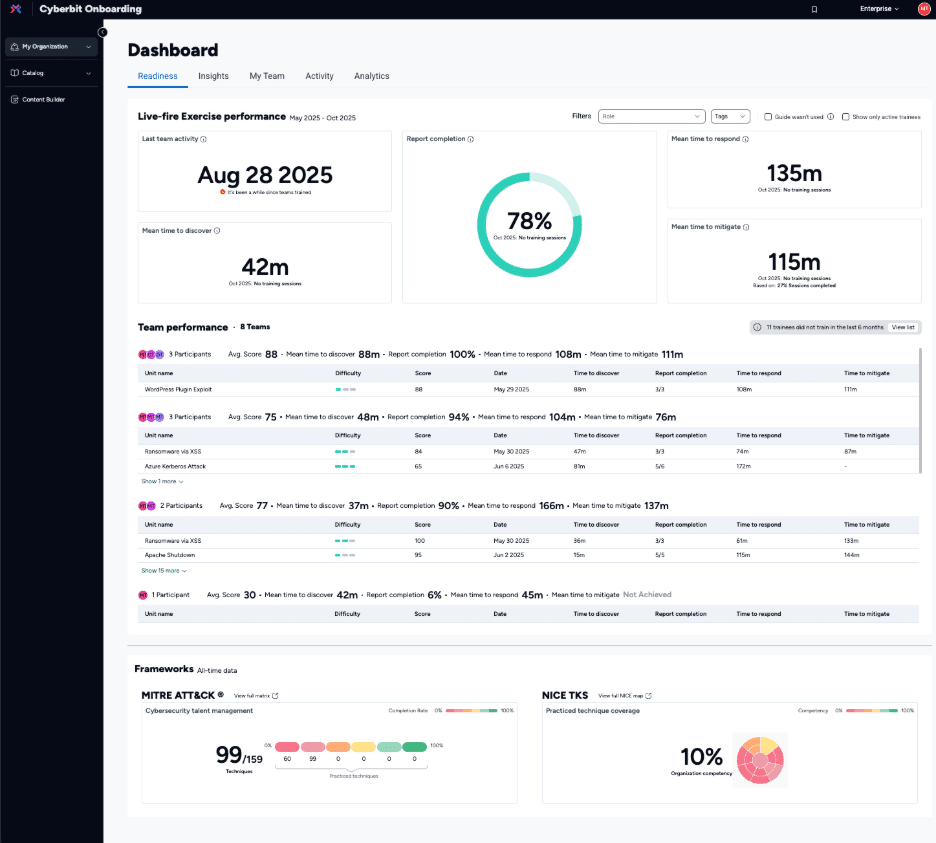
This data-driven feedback loop transforms readiness from a vague aspiration into an operational metric, a measurable pillar of cyber resilience that can be benchmarked, improved, and reported to leadership.
“What I value most is how the platform prepares my team for the real thing and gives me visibility into their readiness, leverages common logic across multiple security platforms, and performs mitigation,” said another Cyberbit customer, VP at a US-based bank. “This visibility we get with the readiness dashboard is a critical insight that often remains segregated to system administrators outside of the Security Operations Centers.”
The evolution of the cyber defense mechanism
The ability to address cyber risk and sustain cyber resilience requires an SOC team that is prepared and optimized.
A SOC team without the full range of cyber skills and hands-on experience will be ill-prepared to combat sophisticated cyber-attacks. Enterprises need cybersecurity professionals who possess foundational cybersecurity skills and knowledge, at an individual and team level, as well as hands-on incident response experience that can be applied when the company is compromised.
And there is no question whether your company will be compromised. The only question is whether your organization has created that critical component of the cyber-defense mechanism: a frontline-ready, battle-hardened SOC team.
In this context, Cyberbit’s recent acquisition of RangeForce marks a pivotal milestone. Combining Cyberbit’s hyper-realistic cyber ranges with RangeForce’s AI-powered, cloud-native cyber readiness platform, organizations now gain access to the most comprehensive offering available.
Together, Cyberbit and RangeForce redefine operational cyber readiness by uniting real-world attack simulation, continuous skills measurement, and adaptive, AI-driven, and experience-based training.
We are empowering businesses and governments worldwide to build SOC teams that are not just prepared, but truly future-proof against the next wave of cyber threats.