Back to Blog
CISOs, CIOs dread it. They toss and turn over it in bed. They wake up in a cold sweat thinking about it. They can’t escape it. They know it is coming. The crisis. But they don’t know when it will happen, where it will hit, or how big it will be. That’s what a cyber crisis readiness plan is for – to prepare organizations for the inevitable, unknown cyber crisis.
But a crisis readiness plan is only as good as its execution. When a crisis strikes, there is no time to fumble around, second-guess your plan or the members of your team, forget the steps in your plan, or lose your cool. You must be able to execute your plan flawlessly, even under the most extreme circumstances. This requires practice and practice requires crisis simulations; they are the key to crisis readiness.
Crisis simulations that matter
For cyber crisis exercises to be effective executive-level teams must be able to practice their crisis response in highly realistic, non-linear crisis simulations where they can train how to adapt and respond in complex, evolving cyber crises. Unlike linear simulations, which have predictable environments and behaviors, non-linear simulations use scenarios with multiple interrelated variables and consider the causal relationship between decisions and outcomes. This leads to simulations with non-intuitive and unpredictable outcomes that more closely mirror the volatile, uncertain, complex, and ambiguous (VUCA) nature of crisis response and readiness.
The predictable environments and behaviors of linear simulations, on the other hand, make them ineffective for developing the critical-thinking and decision-making skills needed during a crisis. Linear simulations offer a checklist of recommended actions based on earlier known experiences and expectations, which is not helpful in a rapidly changing and unpredictable environment. Effective decision making and critical thinking can only be developed by practicing cyber crisis simulations where adaptability is needed.
Crisis simulations that are effective will achieve the following:
- Stress-tests existing crisis management protocols and playbooks, giving stakeholders throughout the organization as realistic an experience as possible.
- Increases the leadership team’s understanding of the impact of a cyber incident and the impact of its decisions.
- Hones the decision-making and critical-thinking skills needed to combat cyber incidents.
- Provides first-hand experience working as a team and with the incident response team during highly stressful conditions.
- Boosts cross-organizational communication, collaboration, and teamwork skills during intense, high-pressure incidents.
- Builds confidence and resilience in the leadership team’s incident response capabilities.
Non-linear crisis simulations that model the impact that decisions have on outcomes make leadership teams aware of the responsibilities and consequences of their decision-making. These simulations are highly effective tools for building, practicing, and improving the skills and knowledge related to critical thinking and decision making and the adaptability needed to mitigate complex cyber crises.
Capabilities of Cyberbit’s crisis simulator:
- Allows you to build a non-linear/linear flow so you can choose the questions, specify who will receive the question, and choose what the answers should be.
- Enables leadership teams to prioritize crisis response actions, for example, leadership can choose to address legal issues, PR issues, or the maintenance of critical business services etc., before addressing other business issues.
- Develops and hones critical thinking, adaptability, and decision-making skills.
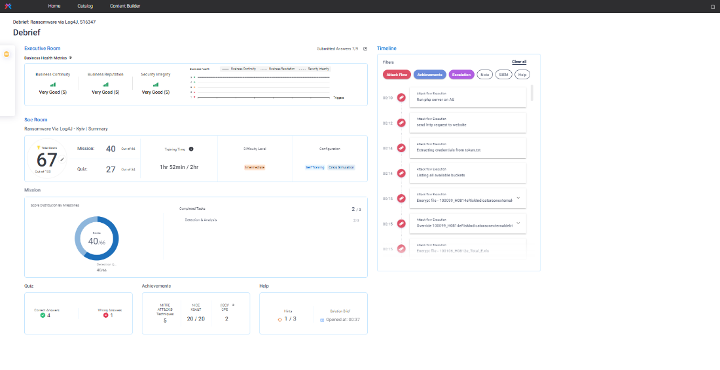
- Reflects every decision that the leadership team makes in real time on a dashboard and shows the business impact of those decisions on the organization (business continuity, business reputation, data integrity, and more)